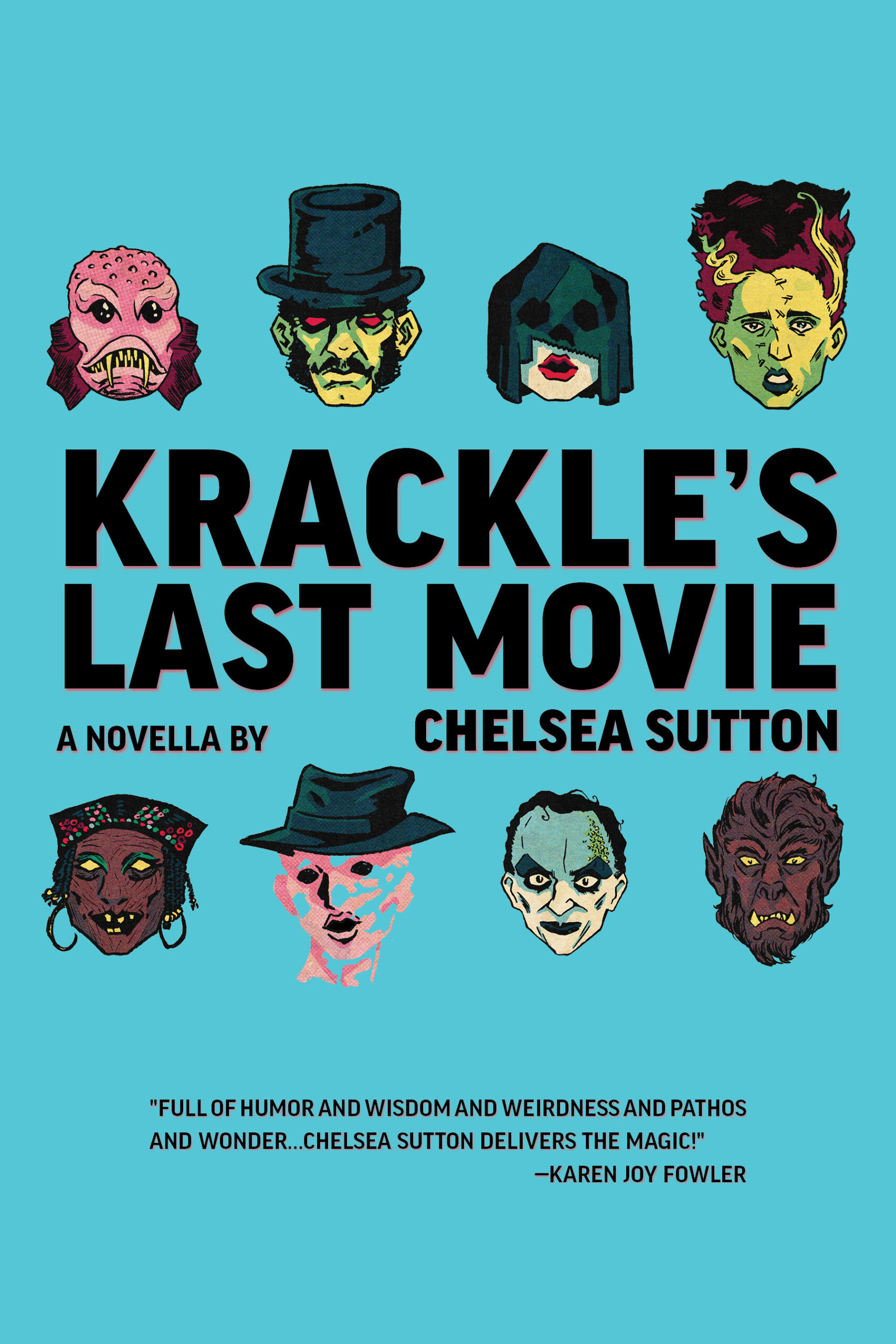
 Debut author Chelsea Sutton describes her style as “gothic whimsy,” and that comes through in her novella Krackle’s Last Movie, in which controversial documentary filmmaker Minerva Krackle goes missing during an interview with a mummy, leaving her assistant, Harper, to complete her final project. As Harper reluctantly shoulders the responsibility, she wonders what Krackle would want while also missing her boss and mentor. In time, she realizes that what really matters the clarity of her own vision.
Superficially, Krackle’s Last Movie is a romp with monsters interviewing monsters alongside awkward clashes between the normal population and the monster population. For horror fans, especially literary horror fans, there’s plenty of body horror, mysterious mummy dust, and tentacles.
On a deeper level, this macabre and often silly novella captures isolation and alienation in a way that would likely fall flat or seem preachy with a more straightforward approach. In Krackle, Time (yes with a capital T) serves as both setting and character. Minerva Krackle often describes herself as being mixed up in Time, by which she means struggles with memory and déjà vu. Journal snippets from Krackles comprise a significant chunk of Harper’s research as so completes the documentary. Krackles frequently describes the feeling that she has seen or heard something before even though she knows it’s technically not possible.
Anyone reading this book will have some déjà vu too, but not just because of the content of the piece. For example, Harper has been growing wings since she was four years old, but her parents cut them off. When they grew back, they tried medical interventions, and eventually spiritual interventions, but the wings kept growing back. As with mental illness, nonbinary identity, queer sexual orientation, or just having a perspective that is outside of the box, Harper internalizes the need to hide her wings and stifle their growth. In Krackle, “There are new internet forums tracking cases of the curious monster syndrome, the mass hysteria event that no one acknowledges, that we’re not allowed to speak about in public.” Harper’s wings, along with all of the other creature parts or features the characters develop, act as a kind of mass hysteria in this novella.
The most powerful horror names what nobody wants to see or just refuses to see. According to Minerva Krackle, “It’s the monster you can’t see that is the scariest. Because it lives in your imagination. Because we’ll always create our own hell, our own private beast to gnaw at our insides. And then pretend like it’s just another Tuesday.” In Krackle, Harper sees colors that nobody else can and gives them names like Irene or Liz. She smells what nobody else can smell. As she continues interviews to round out the documentary and reads Krackle’s journals, she questions a lot of her previous assumptions. As soon as Harper started growing wings, her parents took her to medical specialists who advised them to just cut off the wings. When they continued to grow back, her parents asked the church to intervene. The church tried prayer and when that didn’t work, the pastor convinced her parents that Harper was just evil and the wings were a manifestation of it. Are the terms she has been given to describe herself and her experience accurate, or are they just arbitrary?
Chelsea Sutton’s novella reveals a reality in which anyone could be labeled a monster just for deviating from the established norm. Some of the characters in Krackle have committed horrific acts and are objectively monstrous, but, for the most part, the so-called monsters are not in a Time that understands them yet, as in, these beings are in the world ahead of their time. For example, one of Krackle’s interview subject, The Wondrous Woman, murders people just because she enjoys it and reaches out to the documentary filmmaker just because she wants to be on screen. Meanwhile, other characters, like Harper, have physical attributes that could be viewed as evolution at a more rapid rate than other humans are experiencing. At least, that is the way some of the changes are characterized in this world.
Krackle’s Last Movie is unique, but the strange evolution of humans into creatures reminded me of Shark Heart by Emily Haback and Future Home of the Living God by Louise Erdrich. Throughout, the prose is lighthearted, but the story is dark. Each story reflects on the question: Does deviating from what is normal make us less human, and what are the privileges that come with being perceived as more human?
Publisher: Split/Lip Press
Publication Date: February 10, 2026
Reviewed by Amy Armstrong
Amy Armstrong is a psychotherapist in Aurora, CO. She loves to write and read in her spare time. Amy has been a selector and judge for the Colorado Book Awards for the past two years. She is currently co-editing the 2026 anthology for Rocky Mountain Fiction Writers.